-
Redemption
Maybe my plantar fasciitis,
newly flared up,
is karma for the time I stole
some shampoo and conditioner
(and probably some nail polish)
From Walmart
(okay, that happened more than once)
So, one flash of heel pain for each stolen good?
How does it work?I don’t know when I stopped stealing
(I didn’t find God)
(in fact, I lost him)
But I must have had some moral shoulder-sitter
or at least ingrained capitalism
telling me “hey now, that’s enough”
because I stopped for goodOnce I asked a new date
“What’s the worst thing you’ve ever done?”
(you know, icebreaker)
His answer was probably a 3 out of 10 on the cosmic evil scale
& when he turned the question back on me
I couldn’t think of anything that bad
but I know that if we as a species are good at anything
it is justifying our shitty actions
so maybe I am a shitty person
but I just don’t know it
so I asked my friend later what she thought the worst thing I’d ever done was
And she couldn’t really think of anythingI finally got back to my date with “I used to steal a lot”
which is boring
but I added that maybe my heel pain
is karma from a past life
a more interesting life
where I committed tax fraudOr maybe it is the leftover vestiges of karma
from a truly terrible tyrannical life
hundreds of years ago
which required several lifetimes to deal out
and now the arc of my soul has swung toward “neutral – good”
because my soul is fucking tired
of being evil
maybe I was Genghis Khan -
Reverent Levity
Today, I went back to the place where I found a dead person seven months ago.
At first, I didn’t think I would ever go back. But as the months passed, I thought maybe I would. I could go and offer some words, a prayer, say a final goodbye. Bring something to offer to the departed spirit. I picked up some milkweed seeds recently, and thought I’d plant them near where I found the person. The milkweed, of which bees are so fond, might thrive and become a new home for the threatened insects. Those creatures would live on in a place where one had ceased living. But I never looked up when the best time to plant them is. Doing so would bring me one step closer to going back. And I dreaded going back.
I didn’t plan to go back today. The place where I found the dead person is across the street from my favorite park; across the street and down a tree-lined path in a woodsy area. I went to my park today, which is something I do most days of the week.
But today, I felt somber. My being felt heavy. Equal parts loneliness, uncertainty about my future, despair over family troubles, and dislike for myself. My usual cheerfulness was nowhere to be found, and I wasn’t sure who that other person who lived in my body was and why she smiled a lot.
As I pulled into my usual parking spot at the park, I mused that my mood today might actually be suitable to go and pay respects to the person I had found. It might translate into appropriate reverence once I was there. I was appropriately morose.
The milkweed seeds were at home in my bag, but I decided to go anyway, empty-handed.
It was a cool, breezy morning. Winter had finally arrived in central Texas, and I wanted to cherish every moment. The sun was behind clouds, but I could see that in an hour or so, the clouds would be mostly gone. The sun would shine strongly, and it would become my favorite type of day: cool yet sunny.
I crossed the street and started down the path I hadn’t walked on since May.
The dirt and gravel path cuts behind a neighborhood and is fairly tame on one side (houses, backyards) but wild on the other (dense trees and shrubs). After half a mile or so, it veers away from the houses and becomes a pleasant walk in the woods. The main path branches off in multiple locations to other trails that wind through the trees, but I stayed on the main path until almost the very end.
My heart rate increased and my breathing grew quicker each time I really thought about what I was doing. I had to remind myself that I was safe, that I was in control. For months after I found the person, I had to do the same thing. Every time I was outside in a forested area, my heart would pound at first and I would peer frantically through the trees, expecting to see someone who had ended their life. I would appraise each person who passed me on the trail, especially those whose behavior I found slightly out of the ordinary, and I would worry: Are they about to kill themself?
But I had to stop this. I loved being outside. I needed to allow myself to be outside. What I had seen was a freak thing, a once-in-a-lifetime occurrence. It probably wouldn’t happen again. I needed to get used to being outside again, surrounded by trees again, because that was where I was happiest. A really good therapist helped me with this.
Now, on the path, I took in the surroundings I hadn’t allowed myself to see for over half a year. The path, usually crunchy under my feet, was padded with fallen leaves today. Many leaves had fallen, but many were still hanging onto the trees, crispy and golden brown in the increasing sunlight. I focused on my breathing, on my body moving steadily down the path. I thought about what Thich Nhat Hanh had said: walk as if you are kissing the Earth with your feet.
I came to a part of the path that I knew to be beyond where I had found the person, and I turned around, suddenly disturbed. I thought I had been so mindful. How had I passed the location I had come to see?
I started walking back, slowly, timidly, peering deeply into the trees, searching for the treehouse.
In a few minutes, I spotted the entrance to the offshoot trail that I had missed. It was very subtle and more heavily obscured by brush than it had been seven months ago. I peered beyond it, expecting to see the treehouse, but didn’t.
Was it gone? Had it been taken down? With much trepidation, I crept onto the side trail and stood where I had stood on that muggy May morning: at the top of a slight slope overlooking a thickly brush-lined small clearing. But this morning, there was no treehouse.
I hadn’t expected this. Was there ever even a treehouse here? Was I crazy? Had I made the whole thing up? With even more trepidation than before, I made my way down the slope to get a closer look.
There were signs of the treehouse’s past life. Nails sticking out of trees, a plank still plastered between two of them, a pipe sticking haphazardly out of another one. I released the breath I hadn’t realized I was holding. Why had it been taken down? It had seemed like a great treehouse: not expertly made, to be sure; a little crooked, but still sturdy, still a really cool child’s respite. Maybe it had been deemed unsafe. Maybe someone had hurt themselves here. Or maybe its builder found out that I had found someone on their treehouse, kneeling, with a cord tied around their neck— someone whose face I could not bring myself to look at it, which the brush had (blessedly) obscured, but whose body was unmoving and silent. Maybe the police who I had called didn’t want to be called back for a copycat occurrence. Did the cops have the authority to order the removal of something that should have been so innocent, something that should have been a fortress of childhood joy?
I looked around, peering closely at the trees, gazing deeply at the ground. I didn’t know what I was looking for— a note? A headstone? Milkweed? Finding nothing, I moved back up the slope and sat in a leaf-padded area beside the trail and stared at where the treehouse once was. My eyes filled with tears, but they didn’t fall. Here was the part where I was supposed to say something, offer some words, do something profound.
I should have come here with a plan.
I dug my fingers into the cool, moist earth, as if to transmit my energy to the departed soul. “I’m sorry,” I said, quietly. I really was. I was sorry this world did not give this person, whoever they were, what they needed to be happy. I was sorry the person felt that they needed to take matters into their own hands, so brutally and so finally.
“I hope you are free.” I thought about the people the person had left behind. “I hope your family is… free,” I said, but it sounded stupid, and I wasn’t sure what I meant by that. They probably were not free. They probably missed the person very much.
I wondered, for the thousandth time, what the person had been going through. What had been their final straw?
I remembered coming upon them, seven months ago, and feeling everything in my body come to a complete stop… my breath, my heartbeat, my brain. Just staring at their frozen form. Then fear was the primary emotion; it surged through my veins and electrified my heart. But underneath the fear was something surprising, something I still do not understand. Staring at this person who had presumably taken their own life, I thought: Oh, oh, I understand. I’m so sorry. I understand. I was not suicidal then and I am not suicidal now. And yet my being reached out with empathy to this other being— empathy, not just sympathy. I understand.
Maybe that was a bogus feeling. How could a non-suicidal person ever truly understand? Especially someone like me who thought that suicide was never the answer. Maybe the person’s energy had been lingering, informing me wordlessly of their reasoning. God, life really was heavy sometimes. Even someone like me, who had it pretty good, had to admit that.
Now, sitting with my fingers still plugged into the soil, I offered a mantra chanted by people in my religious tradition: “Nam-myoho-renge-kyo.” I whispered these words three times. The words are laden with meaning, more meaning than I, a five-year-old Buddhist, fully comprehend yet. The words are the title of the Lotus Sutra, a profound teaching by the Buddha that emphasizes, among other things, the worth and dignity of every single human being. It’s a prayer. It’s my offering. Today, it is all I have to give.
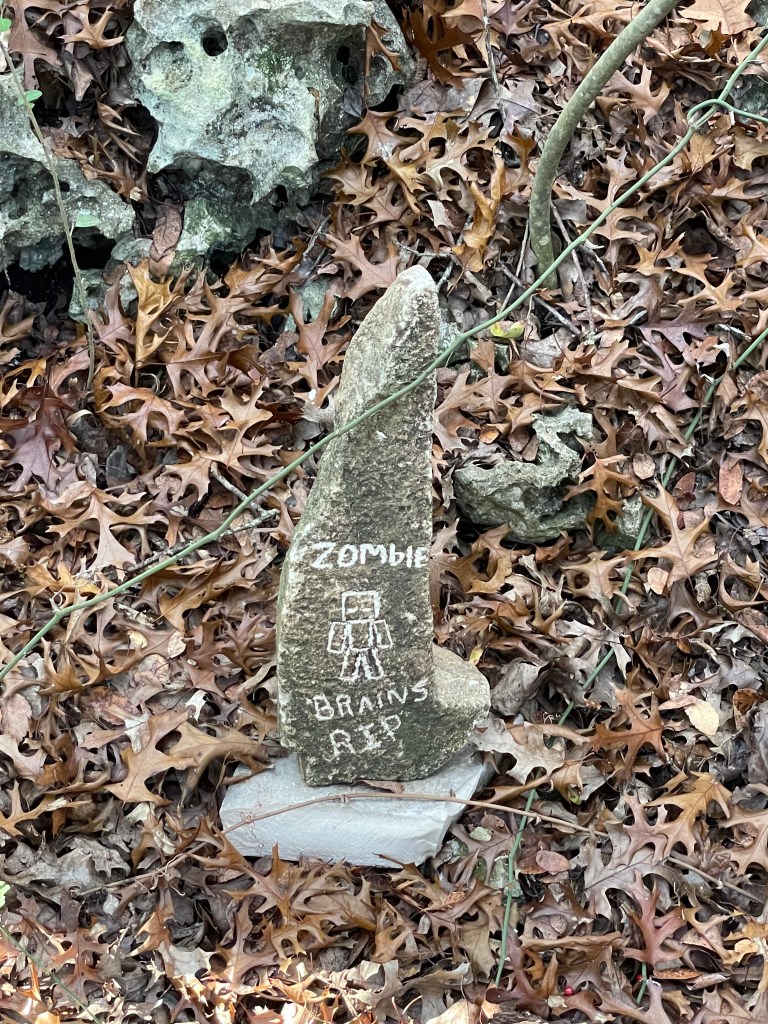
I stood up, dusted myself off, and started to make my way up the slope, when something on the other side of the path caught my eye. It was a stone, roughly triangular shaped, sitting straight on top of a flat piece of stone. There were markings on it.
My heart quickened. Was this the headstone I had almost expected to see earlier?
I crept over to get a closer look. It was a headstone! Scratched mightily into the triangular rock were the words “ZOMBIE BRAINS RIP.”
For a second I didn’t know what to think, and then I was almost annoyed. Zombie brains RIP?! This silly message had no place here in this heavy memory of mine. Didn’t the authors of this headstone know what happened just a few feet away last May? This childish headstone was disrespectful.
But then I took a deep breath and I suddenly felt gratitude for this headstone. A few feet away from me was an imprint of immense pain and grief; yet a few feet in the other direction was an imprint of childhood giggles and happiness. I imagined the laughs bounding through the air as children had carved the words into the rock. God, there was a lot of pain and suffering in the world. And yet, there was also joy, and pleasure and levity. How important it is, that there are those things too.
Smiling a little, I continued up the path and stepped out of the trees and into the sunlight.
-
From destruction… creation
The wise say that you chose your circumstances.
You chose your parents,
you chose to be born in your body,
you chose your life.
I don’t know how it works.
Maybe it’s karma.
Maybe my past choices did the choosing,
did the causing,
which are now affecting.
I look at the last text I received from my father.
Why’d I choose him? I wonder, pitifully.
But then I look at my hand, holding the phone,
and I see him in it.
And my mother,
and the river of ancestors
pooling in me,
who sculpted my hand
like the ridges of a canyon.
And I feel love for this hand,
for my ancestors,
for my father.
The wise say that time is a circle.
An infinite flux of yuga cycles,
ages of creation and destruction.
I look at the last text from my father.
Would I choose him again?
My hand trembles a bit.
I would, I would.
-
Human Revolution Through Compassion and Interbeing
I have become disillusioned with politics as a vehicle for change.
The pendulum swing from one party’s policies to the other is constant and self-negating. As soon as one party gains power, changes made are swiftly undone, and those undone changes will be re-done when the other party re-gains power. It’s a circle. It’s an ouroboros, but not a cool one that you see tattooed on a hot person. It’s chaotic and ultimately accomplishes nothing.
Adin Strauss, the General Director of the Soka Gakkai International USA (SGI-USA), a Buddhist organization, held a virtual lecture August 13th. In response to a question from the audience, Strauss said that what’s urgent is not more political action but rather the transformation of the life state of the humans who make up this country and this world.
Transforming the life state of people can be accomplished through dialogue. Daisaku Ikeda, president of the SGI, is passionate about dialogue as a vehicle for change. Through dialogue, we can achieve a human revolution. In my understanding, the human revolution that we SGI Buddhists talk about is the cumulative effect of individual humans who feel supported, heard, and respected, and go on to show compassion, support, and respect to their fellow human beings. Each human being, after all, has inherent dignity. Compassion ripples outward; Ikeda says that “human revolution is opening your eyes wide and looking beyond your ordinary concerns, striving for and dedicating your actions to something higher, deeper, and broader.” Humans have the ability to change and to constantly strive for self-improvement. We should all probably take a long, hard look at ourselves and see what is not serving us and what we should sacrifice for the wellbeing of others.
Joanna Macy, in her wonderful books World as Lover, World as Self and Active Hope, speaks of two weapons that are needed to combat the evil of the world. The weapons are not items that cause bodily damage and destruction. Rather, they are things we can all cultivate: compassion and insight of our interbeing. Many years ago, a friend of Joanna’s in India told her about these weapons, which are the solutions to strife in the ancient Shambhala warrior prophecy:
“Now is the time the Shambhala warriors go into training. They train in the use of two implements. One is compassion and the other is insight into the radical interdependence of all phenomena. You need both. You need the compassion because that provides the fuel to move you out where you need to be to do what you need to do. That means not being afraid of the suffering of your world. When you’re not afraid to be with that pain, then nothing can stop you. You can be and do what you’re meant to. But by itself that implement is very hot – it can burn you out. So you need that other tool – you need the insight into the radical interconnectivity at the heart of existence, the web of life, our deep ecology. When you have that, then you know that this is not a battle between good guys and bad guys. You know that the line between good and evil runs through the landscape of every human heart. And you know that we are so interwoven in the web of life that even the smallest act, with clear intention, has repercussions through the whole web beyond your capacity to see. But that’s a little cool; maybe even a little abstract. You need the heat of the compassion – the interplay between compassion and wisdom.”
“Compassion and interbeing” has become a mantra for me when I am faced with having a difficult conversation with someone I disagree with. It is a reminder that the other person is another version of me, saddled with difficulties and challenges, just trying to make it through life. People have good reasons for doing what they do— we are all excellent at justifying our own actions. And so, the person in front of me has good reasons for believing what they believe. They are my sister or brother or sibling. They are a fellow Earthling. Can I get out of my own head and put that sentiment foremost? Can I disagree with them and also love and respect them? Carl Sagan said, “If a human disagrees with you, let him live. In a hundred billion galaxies, you will not find another.”
After a SGI discussion meeting or reading a Joanna Macy book, it is easy for me to feel confident about my ability to plunge into a difficult conversation and listen to another person with deep respect for them and their opinion. However, more often than not during such a conversation, I feel not the fire of compassion but instead the fire of anger and impatience. Conversations with family members who deny the reality and seriousness of climate change come to mind. I can enter their homes full of resolve to have a productive conversation in which I share facts with compassion, but I usually end up leaving drained and frustrated from my inability to get any minds to change. Their stubbornness undermines my ability to feel compassion for them in those moments.
Anger and impatience stem from my lesser self. They are a product of ego and the desire to prove not only my worthiness, but my superiority. The desire to change someone’s mind also originates in ego. My greater self recognizes anger and impatience for what they are and does not wish to cultivate them.
Beliefs are deeply rooted and become cherished, integral parts of our self-identities. People tend to fiercely guard their beliefs, and when they are challenged, a shield of rejection is raised. We simply don’t want to hear opposing viewpoints or even facts to erode our cherished beliefs for fear that the foundation we have built ourselves on will crumble. But what if we could understand that our beliefs should not be our foundation? Our obligations to each other should be our foundation. Without respect for one another, without hearing each other out, without having compassion for our neighbors, we don’t have a civilized society. We will be quick to destroy each other if we are not willing to listen to one another.
It is not easy. It will take time. It will take patience. But it is a challenge worth undertaking. Can we love our crooked neighbors with our crooked hearts? Can I recognize that my conservative neighbor has his head up his ass, but he is not unreachable? There is a darkness in the human heart that is uncomfortable to acknowledge— a part that needs healing. It exists in all of us. What if we treated earnest, compassionate, yet difficult dialogue not as a chore, but as an opportunity to practice the one thing that will ensure the continuation of our species?
-
Bowing to buddha-nature
“I heard that somebody threw a beer at Ted Cruz,” James* said in his rich southern accent. “Now, that’s just about the worst thing you could do to somebody. I don’t care who he is; that man is a human being.”
I looked at the faces in the Zoom room: four squares of nodding heads, plus James’s square, partly obstructed by a virtual background he had asked his granddaughter to get rid of (she had been unsuccessful). We were a motley crew: we had representatives from the age groups of 70s, 60s, 30s, and 20s, and a near-even mixture of men and women. On other days, we had Asian and Indian friends among us, but today we were mostly white, with the exception of James, who is Black. Our uniting factor was that we were all practitioners of SGI Buddhism, come together for a study meeting. My favorite thing about these study meetings is that the diversity of the organization really shines through in them. I relish the opportunity to hear from elders, who typically take my breath away with the wisdom they’ve gained from being a human for decades longer than I have.
“Now, I can think of few people I agree with less than Ted Cruz,” continued James. “I don’t like the man at all. But I would still bow to him. I would bow to his buddha-nature. I would bow to the enlightened potential of anyone I don’t agree with.”
He went on to say that we need people with different opinions. If we didn’t have people giving us a reason to fight, we would not have anything to fight for.
In “Be Here Now,” Ram Dass said:
“Hippies create police
Police create hippies
If you’re in polarity, you’re creating opposites
You can only protest effectively when you love the person whose ideas you are protesting against as much as you love yourself.”
He also said,
“The only way out of that is to take the poles of every set of opposites and see the way in which they are one. And: if you can get into that place where you see the interrelatedness of everything, and you see the oneness in it all, then no longer are you attached to your polarized position.”
The answer is not throwing a beer at someone you don’t like. The answer is dialogue. We have a duty to talk to our fellow humans, who are endowed with buddha-naturejust as we are. I think that most of the time we are talking only to those who identify with the groups we identify with. That doesn’t cause a spark. There is no friction and there is no fire.
“If a man gives way to all his desires, or panders to them, there will be no inner struggle in him, no ‘friction’, no fire. But if, for the sake of attaining a definite aim, he struggles with the desires that hinder him— he will then create a fire which will gradually transform his inner world into a single whole.”
Ouspensky, quoted by Ram Dass in “Be Here Now”I have a desire to be right. With politics, with religion, with everything I have an opinion about. I want to be right. I desire group membership; identification with others. My ego longs to identify with a cause, and people, I respect. It longs to be involved in the correct course of action so it can tell itself that it is doing a good job and that it is correct and that it is worthy.
But what if I am already worthy despite my identifications? What if the real difference between groups in opposite poles— Republican and Democrat, hippie and police, etcetera— is simply the group identification one chooses? Nothing deeper than that?
Buddha-nature, the capacity for boundless compassion and wisdom, exists in us all, even people we don’t like. People are worthy of respect whether you think they are or not.
My challenge to myself is to bow to the buddha-nature in a human I don’t like, and engage them in dialogue. There may be more commonality between us than either of us would ever imagine beyond the layers of complex labels and identities we’ve mummified ourselves with.
As a privileged white woman, it may be easy for me to pull the “we’re all one” card. I have experienced relatively few challenges as a result of the body I find myself in, although I do harbor a handful of marginalized identities. I do not mean to trivialize the real suffering that people like police and racists cause. Finding common ground with a fellow human does not excuse them from any suffering they have caused. Racists are not people I want to make friends with. And yet, if racists are shown no friction to their beliefs, the fire of transformation will not be possible for them. If they are not challenged— and challenged in a calm way, through dialogue, so they do not immediately close their ears— how will they ever recognize the buddha-nature in those they cast evil toward?
How will they ever recognize their own buddha-nature— that underlying capacity for goodness that exists in all of us, even the very worst of us?
What if recognizing that takes their breath away?
*I used a pseudonym since I did not ask for permission to share this person’s words.
-
Subscribe
Subscribed
Have a WordPress.com account? Log in now.

