Today, I went back to the place where I found a dead person seven months ago.
At first, I didn’t think I would ever go back. But as the months passed, I thought maybe I would. I could go and offer some words, a prayer, say a final goodbye. Bring something to offer to the departed spirit. I picked up some milkweed seeds recently, and thought I’d plant them near where I found the person. The milkweed, of which bees are so fond, might thrive and become a new home for the threatened insects. Those creatures would live on in a place where one had ceased living. But I never looked up when the best time to plant them is. Doing so would bring me one step closer to going back. And I dreaded going back.
I didn’t plan to go back today. The place where I found the dead person is across the street from my favorite park; across the street and down a tree-lined path in a woodsy area. I went to my park today, which is something I do most days of the week.
But today, I felt somber. My being felt heavy. Equal parts loneliness, uncertainty about my future, despair over family troubles, and dislike for myself. My usual cheerfulness was nowhere to be found, and I wasn’t sure who that other person who lived in my body was and why she smiled a lot.
As I pulled into my usual parking spot at the park, I mused that my mood today might actually be suitable to go and pay respects to the person I had found. It might translate into appropriate reverence once I was there. I was appropriately morose.
The milkweed seeds were at home in my bag, but I decided to go anyway, empty-handed.
It was a cool, breezy morning. Winter had finally arrived in central Texas, and I wanted to cherish every moment. The sun was behind clouds, but I could see that in an hour or so, the clouds would be mostly gone. The sun would shine strongly, and it would become my favorite type of day: cool yet sunny.
I crossed the street and started down the path I hadn’t walked on since May.
The dirt and gravel path cuts behind a neighborhood and is fairly tame on one side (houses, backyards) but wild on the other (dense trees and shrubs). After half a mile or so, it veers away from the houses and becomes a pleasant walk in the woods. The main path branches off in multiple locations to other trails that wind through the trees, but I stayed on the main path until almost the very end.
My heart rate increased and my breathing grew quicker each time I really thought about what I was doing. I had to remind myself that I was safe, that I was in control. For months after I found the person, I had to do the same thing. Every time I was outside in a forested area, my heart would pound at first and I would peer frantically through the trees, expecting to see someone who had ended their life. I would appraise each person who passed me on the trail, especially those whose behavior I found slightly out of the ordinary, and I would worry: Are they about to kill themself?
But I had to stop this. I loved being outside. I needed to allow myself to be outside. What I had seen was a freak thing, a once-in-a-lifetime occurrence. It probably wouldn’t happen again. I needed to get used to being outside again, surrounded by trees again, because that was where I was happiest. A really good therapist helped me with this.
Now, on the path, I took in the surroundings I hadn’t allowed myself to see for over half a year. The path, usually crunchy under my feet, was padded with fallen leaves today. Many leaves had fallen, but many were still hanging onto the trees, crispy and golden brown in the increasing sunlight. I focused on my breathing, on my body moving steadily down the path. I thought about what Thich Nhat Hanh had said: walk as if you are kissing the Earth with your feet.
I came to a part of the path that I knew to be beyond where I had found the person, and I turned around, suddenly disturbed. I thought I had been so mindful. How had I passed the location I had come to see?
I started walking back, slowly, timidly, peering deeply into the trees, searching for the treehouse.
In a few minutes, I spotted the entrance to the offshoot trail that I had missed. It was very subtle and more heavily obscured by brush than it had been seven months ago. I peered beyond it, expecting to see the treehouse, but didn’t.
Was it gone? Had it been taken down? With much trepidation, I crept onto the side trail and stood where I had stood on that muggy May morning: at the top of a slight slope overlooking a thickly brush-lined small clearing. But this morning, there was no treehouse.
I hadn’t expected this. Was there ever even a treehouse here? Was I crazy? Had I made the whole thing up? With even more trepidation than before, I made my way down the slope to get a closer look.
There were signs of the treehouse’s past life. Nails sticking out of trees, a plank still plastered between two of them, a pipe sticking haphazardly out of another one. I released the breath I hadn’t realized I was holding. Why had it been taken down? It had seemed like a great treehouse: not expertly made, to be sure; a little crooked, but still sturdy, still a really cool child’s respite. Maybe it had been deemed unsafe. Maybe someone had hurt themselves here. Or maybe its builder found out that I had found someone on their treehouse, kneeling, with a cord tied around their neck— someone whose face I could not bring myself to look at it, which the brush had (blessedly) obscured, but whose body was unmoving and silent. Maybe the police who I had called didn’t want to be called back for a copycat occurrence. Did the cops have the authority to order the removal of something that should have been so innocent, something that should have been a fortress of childhood joy?
I looked around, peering closely at the trees, gazing deeply at the ground. I didn’t know what I was looking for— a note? A headstone? Milkweed? Finding nothing, I moved back up the slope and sat in a leaf-padded area beside the trail and stared at where the treehouse once was. My eyes filled with tears, but they didn’t fall. Here was the part where I was supposed to say something, offer some words, do something profound.
I should have come here with a plan.
I dug my fingers into the cool, moist earth, as if to transmit my energy to the departed soul. “I’m sorry,” I said, quietly. I really was. I was sorry this world did not give this person, whoever they were, what they needed to be happy. I was sorry the person felt that they needed to take matters into their own hands, so brutally and so finally.
“I hope you are free.” I thought about the people the person had left behind. “I hope your family is… free,” I said, but it sounded stupid, and I wasn’t sure what I meant by that. They probably were not free. They probably missed the person very much.
I wondered, for the thousandth time, what the person had been going through. What had been their final straw?
I remembered coming upon them, seven months ago, and feeling everything in my body come to a complete stop… my breath, my heartbeat, my brain. Just staring at their frozen form. Then fear was the primary emotion; it surged through my veins and electrified my heart. But underneath the fear was something surprising, something I still do not understand. Staring at this person who had presumably taken their own life, I thought: Oh, oh, I understand. I’m so sorry. I understand. I was not suicidal then and I am not suicidal now. And yet my being reached out with empathy to this other being— empathy, not just sympathy. I understand.
Maybe that was a bogus feeling. How could a non-suicidal person ever truly understand? Especially someone like me who thought that suicide was never the answer. Maybe the person’s energy had been lingering, informing me wordlessly of their reasoning. God, life really was heavy sometimes. Even someone like me, who had it pretty good, had to admit that.
Now, sitting with my fingers still plugged into the soil, I offered a mantra chanted by people in my religious tradition: “Nam-myoho-renge-kyo.” I whispered these words three times. The words are laden with meaning, more meaning than I, a five-year-old Buddhist, fully comprehend yet. The words are the title of the Lotus Sutra, a profound teaching by the Buddha that emphasizes, among other things, the worth and dignity of every single human being. It’s a prayer. It’s my offering. Today, it is all I have to give.
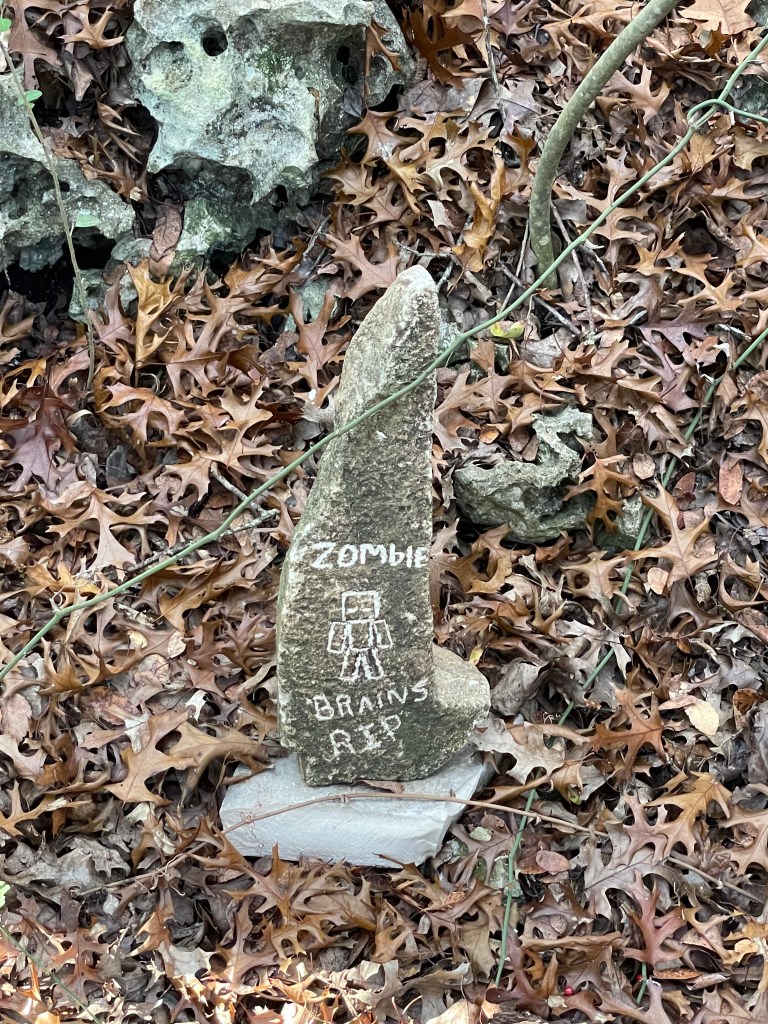
I stood up, dusted myself off, and started to make my way up the slope, when something on the other side of the path caught my eye. It was a stone, roughly triangular shaped, sitting straight on top of a flat piece of stone. There were markings on it.
My heart quickened. Was this the headstone I had almost expected to see earlier?
I crept over to get a closer look. It was a headstone! Scratched mightily into the triangular rock were the words “ZOMBIE BRAINS RIP.”
For a second I didn’t know what to think, and then I was almost annoyed. Zombie brains RIP?! This silly message had no place here in this heavy memory of mine. Didn’t the authors of this headstone know what happened just a few feet away last May? This childish headstone was disrespectful.
But then I took a deep breath and I suddenly felt gratitude for this headstone. A few feet away from me was an imprint of immense pain and grief; yet a few feet in the other direction was an imprint of childhood giggles and happiness. I imagined the laughs bounding through the air as children had carved the words into the rock. God, there was a lot of pain and suffering in the world. And yet, there was also joy, and pleasure and levity. How important it is, that there are those things too.
Smiling a little, I continued up the path and stepped out of the trees and into the sunlight.

 embracing samsara